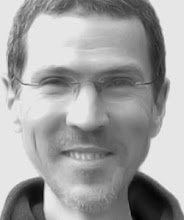
My “Bearable Lightness” is a far cry from Milan Kundera’s “Unbearable Lightness of Being”, free from the deep social philosophies and political clouds of the Czechoslovak Communist period in 1968. Indeed my experience really is about lightness and freedom as opposed to darkness and complexity.
One of the effects of my condition is that I am extremely thin. Extremely with a capital E! I keep waiting for Hollywood to phone asking me to play the lead role in a starved prisoner of war movie. They wouldn't need any special effects, lighting or make up, I would just fit right in! Someone once told me that dystrophy was known as “stickman’s disease”. Well, that's just me, a stickman, on a diet!
This skinny-ness of course comes hand-in-hand with lightweight, something which mostly works in my favour. My slim profile enables me to use a very narrow wheelchair which in turn translates into one which can enter, exit, and navigate confined spaces very easily. My low weight saves me from the dangers posed by pressure sores and extended seating. Every so often this (s)lightness of being leads to some interesting interactions.
Once in a while I come across someone who feels that my skinny condition is somehow self-inflicted, apparently through a bad choice of diet. I, of course, know this to be untrue but when some folk get an idea in their head it is impossible to budge it and they are best left to run their course. When I was admitted to hospital in 1977 for a Harrington Rod spinal fusion operation the senior nursing sister took my light weight is something of a challenge, with a public decree that she would fatten me up during my stay under her care. I have to give her credit for a steadfast determination and bulldog-like unwillingness to give up, but when I did finally check out of hospital nine months later I was exactly the same weight as when I was admitted! I could easily have dismissed her failure on the basis of the awful hospital food which we were subjected to, but my parents had brought me a full supper every night (with pudding!), over and above the lunch and supper that was provided by the hospital, thereby giving her every possible chance of success. In fairness she did concede defeat in a very magnanimous manner, albeit quite baffled as to why all her efforts had been in vain, and with her confidence as a fatter-upper somewhat dented.
My light weight does not bother me in any psychological way and I have never felt the need to be ashamed or hesitant about it. It is the way I am, I've always been, and probably always will be. Not everyone shares this view however, and particularly in the corporate world one is expected to fit into certain predefined criteria. The only time I can recall ever having to be consciously deceptive about my light weight was when I applied for my first job at Old Mutual way back in 1978. They decided that before my job interview I should first be examined by their in-house doctor on the understanding that if he found something disturbing Old Mutual could cancel the interview without obligation to me. These days I am sure there is some law against such activity, but this was 30+ years ago and the times were very different. I had the medical examination and then the time came to weigh me. This presented a challenge to the doctor who was not quite sure how to manage it and ended up leaving me and my father alone in his examination room with a scale. My father weighed himself, then picked me up out of my wheelchair and weighed both of us, not an easy feat as you will discover if you try it yourself. The difference was, naturally, my weight, but when we wrote the figure down on the application form it looked so small that we added 20 kg to the figure! No one questioned it, my interview was successful, I went on to work for the company for the next 10 years, and the rest, as they say, is history.
My wife once confided to me that she always hoped that her husband would carry her over the threshold in the traditionally accepted manner of newlyweds. The choice therefore of me as her life partner made this something of a challenge, but it did present the opportunity for a role reversal. Someone was carried over the threshold, but the carry-er was not me, and the carry-ee was not her!
I have little doubt that my “undernourished” appearance is one of the main contributing factors to my being a target for would be donation givers as has been discussed in previous blog entries. There is nothing quite like the sight of a gaunt disabled person to tug on your purse strings! Whilst the merits or de-merits of this can be discussed in great detail my thoughts on this rather strange aspect of my life are well known. One group of people who never shy away from forthright observation and questioning are children, and the fact that most eight-year-olds have more meat on their bones than I do tends to attract attention from the little devils. Sometime ago I had one youngster ask me quite openly why I was so thin. Quick as a flash a friend replied “because he never ate his vegetables”! There were startled looks all around, and then gales of laughter. It was a moment of brilliance which I am sure paid dividends for many years thereafter every time there may have been some of eating resistance at the dinner table.
Wednesday, April 18, 2012

Sunday, September 18, 2011
The Way Things Should Always Be.
It is always refreshing to learn of a new B&B which is wheelchair accessible. It is even more enjoyable when a B&B is located in our favourite town of Robertson, in the heart of the Western Cape and on the famous Route 62. A tremendous amount of good work has been put into making as many of the wine farms in the Robertson Valley accessible as possible, and in the process a number of accommodation establishments have also modified the facility to more easily accept disabled tourists.
GUBAS DE HOEK is located in the heart of the town yet provides a level of peace and tranquillity which allows one to fully relax and shake off the stresses of work. As we have come to experience in our country towns our hostess Balbina made us feel most welcome on arrival, helped along with a much-needed cup of tea and delicious biscuits!
Balbina had of course already been in communication with me when I made my first enquiry. At that point she e-mailed me an extensive and detailed document outlining the accessible facilities that she was able to provide. When someone goes to this level of care you sit up and take note! Balbina explained all the facilities, which ranged from the accessible parking through to a well thought out and fully equipped bedroom and bathroom. A great deal of consideration appears to have gone into the construction of the work areas, cupboards, hand basins, shower, etc. All too often we have encountered accommodation where the rooms have been modified in order to try and provide accessibility. Somehow they never seem “right” and important features are often omitted. In the case of GUBAS DE HOEK accessibility appears to have come first, and the rooms are designed from that point forward. Everything works well together and there is a logic and flow to the rooms which make them easy to live in. It really is the way things should always be.
Paved paths lead through the garden and connect to the main house which offers a lounge and dining area, all of which is accessible. We were provided with a remote control for the front gate, which allowed us to come and go as we pleased. A measure of the standard of accessibility is usually the ease with which one relaxes and settles into a holiday mode. Whenever we have looked back, whether it be a long weekend getaway or a multiweek holiday, and commented about how easy it was to travel, that invariably was as a result of the accommodation being wheelchair friendly. When one's holiday “home” is welcoming and comfortable it sets the right tone for all else that follows.
I can strongly recommend GUBAS DE HOEK in Robertson is an excellent base from which to explore the valley and everything it has to offer a disabled tourist.
GUBAS DE HOEK
Gunther and Balbina Huerttlen
Tel. / Fax : 023 626 6218
eMail : info@gubas-dehoek.com
Website : www.gubas-dehoek.com

GUBAS DE HOEK is located in the heart of the town yet provides a level of peace and tranquillity which allows one to fully relax and shake off the stresses of work. As we have come to experience in our country towns our hostess Balbina made us feel most welcome on arrival, helped along with a much-needed cup of tea and delicious biscuits!
Balbina had of course already been in communication with me when I made my first enquiry. At that point she e-mailed me an extensive and detailed document outlining the accessible facilities that she was able to provide. When someone goes to this level of care you sit up and take note! Balbina explained all the facilities, which ranged from the accessible parking through to a well thought out and fully equipped bedroom and bathroom. A great deal of consideration appears to have gone into the construction of the work areas, cupboards, hand basins, shower, etc. All too often we have encountered accommodation where the rooms have been modified in order to try and provide accessibility. Somehow they never seem “right” and important features are often omitted. In the case of GUBAS DE HOEK accessibility appears to have come first, and the rooms are designed from that point forward. Everything works well together and there is a logic and flow to the rooms which make them easy to live in. It really is the way things should always be.
Paved paths lead through the garden and connect to the main house which offers a lounge and dining area, all of which is accessible. We were provided with a remote control for the front gate, which allowed us to come and go as we pleased. A measure of the standard of accessibility is usually the ease with which one relaxes and settles into a holiday mode. Whenever we have looked back, whether it be a long weekend getaway or a multiweek holiday, and commented about how easy it was to travel, that invariably was as a result of the accommodation being wheelchair friendly. When one's holiday “home” is welcoming and comfortable it sets the right tone for all else that follows.
I can strongly recommend GUBAS DE HOEK in Robertson is an excellent base from which to explore the valley and everything it has to offer a disabled tourist.
GUBAS DE HOEK
Gunther and Balbina Huerttlen
Tel. / Fax : 023 626 6218
eMail : info@gubas-dehoek.com
Website : www.gubas-dehoek.com

Saturday, August 13, 2011
Spin -vs- Reality
I recently read an article, or was it an advertorial, entitled “In Place / SAA Customer Service” by Steve Allison in a local disability magazine. I read the article extoling the virtues of SAA/ACSA twice, and my wife then read it, and we came to the conclusion that we must be living in some sort of a parallel universe because the SAA described was certainly not the same SAA we experienced earlier this year, or in recent years for that matter.
I booked and purchased two SAA tickets in January for a flight from Cape Town to Durban, and, trying to do the right thing called their offices to confirm that I was in a wheelchair, and would need the services of their PAU. My call was handled in a very offhand manner by someone who could barely speak English, and then to top it all I was told they “would decide if I could fly or not” but I had to phone them to find out if I was to be so lucky! I called each week, and each time was given a different excuse as to why a decision had not been taken. After a month, and with the departure date now only a week away I was told that because the flights had been sub-contracted to SA Express and Mango they could not guarantee that I would be loaded on the aircraft. SAA fobbed me off on Mango, Mango claimed it was not their problem, and SA Express were not even interested in talking to me. After calling in some contacts I was able to secure an eMail from SAA stating that I would be boarded. None of the promised returns of calls ever materialised.
On the return leg I requested a luggage tag/receipt for my wheelchair (one is not covered by insurance without it). The check-in counter told me that the boarding gate would provide one. The boarding gate told me that the air crew would provide one, which was of course absolute nonsense, and they knew it. Past experience has taught me not to wait until one is at the doorway of the aircraft, was the engines roaring in the background, to resolve these issues. Nor should one wait until being seated and all your negotiating power is lost. I was informed that I was being “difficult” because I insisted on a receipt, not and did not leave the airport building before I had received it .
My seats had been allocated mid-plane? Why is anyone’s guess as the aircraft was barely half full and there were seats available nearer to the entrances/exits. The slipper chairs provided no upper body support and had no chest straps for me, even when being carried manually down the stairs out of the one aircraft (I thought we had left that method behind years ago). The staff did not appear to understand the consequences of no upper body support, so my wife had to hold my shoulders else I would have toppled over. It was like being in a time warp back to my first flight back in 1981 when disabled travel was virtually unheard of.
The disturbing fact that comes through time and time again with my travels is a fundamental lack of understanding of the purpose of their jobs by the SAA/ACSA staff. One gets the distinct impression that a disabled passenger and their wheelchair are viewed merely as yet another item of luggage. That impression is all too often reinforced by the manner in which one is handled both physically and mentally. The most frustrating aspect of these encounters is that I know personally that during the late 1980s and early 1990s a tremendous amount of good work was done between the disabled advocacy groups and SAA/ACSA. Sadly it appears that with the changes in these companies, the retrenchments and replacements in staff, the knowledge and expertise that had been developed has been lost.
ACSA are still trapped in the old aircraft boarding mindset used prior to all our major airports having walk-on tunnels to the aircraft. They do not appear to understand that with the advent of the walk-on tunnels there is no longer a need to use a PAU (passenger assistance unit). Everywhere else in the world one waits at the boarding gate, the ground staff wheel you down the tunnel prior to boarding, get one seated, pass the wheelchair to luggage services, and then load the remaining passengers. Here in South Africa ACSA take one out the building, load one onto a PAU, drive to the aircraft, raise the PAU, offload you from the PAU, seat, take the wheelchair back onto the PAU, down to the ground, stow the wheelchair, and then back to the airport building. It’s insane. When we landed at our destination my wife asked them to bring up my wheelchair, she loaded me in, and we walked off down the tunnel. The whole process took less than two minutes. The ground staff were dumbfounded and stared at us open mouthed has we disappeared down the tunnel into the airport building. They appeared to have never thought of that before.
As I said earlier, this is not an isolated incident. My experiences with SAA and ACSA have found them to be uncommunicative, rude, aggressive and on occasions deceitful. My travelling companions have often expressed shock and embarrassment at the manner in which I have been treated and handled by the staff. It has subsequently come to light that SAA/ACSA is sponsoring various disabled initiatives, hence the fluff piece about their customer service.
SAA/ACSA caring companies?
I remain unconvinced.
I booked and purchased two SAA tickets in January for a flight from Cape Town to Durban, and, trying to do the right thing called their offices to confirm that I was in a wheelchair, and would need the services of their PAU. My call was handled in a very offhand manner by someone who could barely speak English, and then to top it all I was told they “would decide if I could fly or not” but I had to phone them to find out if I was to be so lucky! I called each week, and each time was given a different excuse as to why a decision had not been taken. After a month, and with the departure date now only a week away I was told that because the flights had been sub-contracted to SA Express and Mango they could not guarantee that I would be loaded on the aircraft. SAA fobbed me off on Mango, Mango claimed it was not their problem, and SA Express were not even interested in talking to me. After calling in some contacts I was able to secure an eMail from SAA stating that I would be boarded. None of the promised returns of calls ever materialised.
On the return leg I requested a luggage tag/receipt for my wheelchair (one is not covered by insurance without it). The check-in counter told me that the boarding gate would provide one. The boarding gate told me that the air crew would provide one, which was of course absolute nonsense, and they knew it. Past experience has taught me not to wait until one is at the doorway of the aircraft, was the engines roaring in the background, to resolve these issues. Nor should one wait until being seated and all your negotiating power is lost. I was informed that I was being “difficult” because I insisted on a receipt, not and did not leave the airport building before I had received it .
My seats had been allocated mid-plane? Why is anyone’s guess as the aircraft was barely half full and there were seats available nearer to the entrances/exits. The slipper chairs provided no upper body support and had no chest straps for me, even when being carried manually down the stairs out of the one aircraft (I thought we had left that method behind years ago). The staff did not appear to understand the consequences of no upper body support, so my wife had to hold my shoulders else I would have toppled over. It was like being in a time warp back to my first flight back in 1981 when disabled travel was virtually unheard of.
The disturbing fact that comes through time and time again with my travels is a fundamental lack of understanding of the purpose of their jobs by the SAA/ACSA staff. One gets the distinct impression that a disabled passenger and their wheelchair are viewed merely as yet another item of luggage. That impression is all too often reinforced by the manner in which one is handled both physically and mentally. The most frustrating aspect of these encounters is that I know personally that during the late 1980s and early 1990s a tremendous amount of good work was done between the disabled advocacy groups and SAA/ACSA. Sadly it appears that with the changes in these companies, the retrenchments and replacements in staff, the knowledge and expertise that had been developed has been lost.
ACSA are still trapped in the old aircraft boarding mindset used prior to all our major airports having walk-on tunnels to the aircraft. They do not appear to understand that with the advent of the walk-on tunnels there is no longer a need to use a PAU (passenger assistance unit). Everywhere else in the world one waits at the boarding gate, the ground staff wheel you down the tunnel prior to boarding, get one seated, pass the wheelchair to luggage services, and then load the remaining passengers. Here in South Africa ACSA take one out the building, load one onto a PAU, drive to the aircraft, raise the PAU, offload you from the PAU, seat, take the wheelchair back onto the PAU, down to the ground, stow the wheelchair, and then back to the airport building. It’s insane. When we landed at our destination my wife asked them to bring up my wheelchair, she loaded me in, and we walked off down the tunnel. The whole process took less than two minutes. The ground staff were dumbfounded and stared at us open mouthed has we disappeared down the tunnel into the airport building. They appeared to have never thought of that before.
As I said earlier, this is not an isolated incident. My experiences with SAA and ACSA have found them to be uncommunicative, rude, aggressive and on occasions deceitful. My travelling companions have often expressed shock and embarrassment at the manner in which I have been treated and handled by the staff. It has subsequently come to light that SAA/ACSA is sponsoring various disabled initiatives, hence the fluff piece about their customer service.
SAA/ACSA caring companies?
I remain unconvinced.
Friday, July 29, 2011
Don’t sit still!
They've been at it again, the money lenders, or more correctly the money givers. This time it was a mother and child.
I have discussed this "problem" before.
http://hiltonp-twotrains.blogspot.com/2009_08_01_archive.html
I thought I was in one of those National Geographic wildlife programmes, you know the ones, where the parent lioness manages to capture a helpless impala but instead of despatching it herself she summons in her youngsters to do the job so that they may learn from practical experience. I felt a bit like a young impala, positioned as I was with my back to the window of a store in the local shopping mall. The lioness, in this case a well-meaning one, had me cornered, and gathered up her offspring with a handful of loose change. Unlike the bushveld scene I managed to defuse the situation and allow all the parties concerned to escape with some dignity.
I have however determined the primary reason why I become the target of money givers in public places. It only ever happens when I sit still. It's never happens when I'm on the move. Somehow sitting still in one spot for any length of time triggers a flag which says "beggar". When I'm in my powerchair, and moving, I seem to become part of the crowd and the only attention I attract is from children interested in my “pram” and startled adults eager to get out of my way. If I stop for any length of time, particularly if I am on my own and not talking to anyone, then that flag goes up again and the money lenders begin to close in.
Initially when I started to experience this problem I wondered how anyone could confuse me with the beggar since I was using a powerchair, none of which come cheap, and was freshly shampooed, shaved, and sh-----, um, dressed. I have now come to realise that it has nothing to do with my appearance but has everything to do with my movement, or the lack thereof.
In a bizarre incident the other day I happened to be waiting for my wife on one side of a shopping mall entrance whilst on the other side was another gentleman in a wheelchair doing fundraising for a local charitable institution. It took all of my efforts to ensure that the would-be donors directed their attention to that gentleman, his collection banner and tin, rather than towards me. Perhaps I am missing my vocation and should be offering my services as a tin shaker to fundraising institutions. Do they work on a commission basis?
It seems that in our human world we are the opposite of that young impala which opened this piece. Their lives are all about flight or freezing. Flight attracts the attention of predators while freezing in the long grass can make one invisible to those around you. In our human world, flight, or keeping on the move, allows us to blend in, while freezing in the open plains of mall-land draws unwarranted attention. Perhaps David Attenborough should do a National Geographic programme on this phenomena, or perhaps not.
I have discussed this "problem" before.
http://hiltonp-twotrains.blogspot.com/2009_08_01_archive.html
I thought I was in one of those National Geographic wildlife programmes, you know the ones, where the parent lioness manages to capture a helpless impala but instead of despatching it herself she summons in her youngsters to do the job so that they may learn from practical experience. I felt a bit like a young impala, positioned as I was with my back to the window of a store in the local shopping mall. The lioness, in this case a well-meaning one, had me cornered, and gathered up her offspring with a handful of loose change. Unlike the bushveld scene I managed to defuse the situation and allow all the parties concerned to escape with some dignity.
I have however determined the primary reason why I become the target of money givers in public places. It only ever happens when I sit still. It's never happens when I'm on the move. Somehow sitting still in one spot for any length of time triggers a flag which says "beggar". When I'm in my powerchair, and moving, I seem to become part of the crowd and the only attention I attract is from children interested in my “pram” and startled adults eager to get out of my way. If I stop for any length of time, particularly if I am on my own and not talking to anyone, then that flag goes up again and the money lenders begin to close in.
Initially when I started to experience this problem I wondered how anyone could confuse me with the beggar since I was using a powerchair, none of which come cheap, and was freshly shampooed, shaved, and sh-----, um, dressed. I have now come to realise that it has nothing to do with my appearance but has everything to do with my movement, or the lack thereof.
In a bizarre incident the other day I happened to be waiting for my wife on one side of a shopping mall entrance whilst on the other side was another gentleman in a wheelchair doing fundraising for a local charitable institution. It took all of my efforts to ensure that the would-be donors directed their attention to that gentleman, his collection banner and tin, rather than towards me. Perhaps I am missing my vocation and should be offering my services as a tin shaker to fundraising institutions. Do they work on a commission basis?
It seems that in our human world we are the opposite of that young impala which opened this piece. Their lives are all about flight or freezing. Flight attracts the attention of predators while freezing in the long grass can make one invisible to those around you. In our human world, flight, or keeping on the move, allows us to blend in, while freezing in the open plains of mall-land draws unwarranted attention. Perhaps David Attenborough should do a National Geographic programme on this phenomena, or perhaps not.
Tuesday, June 7, 2011
Two Trains
In 1978 Lowell George wrote a song titled Two Trains. Its opening lyrics go :
“two trains running, on one line,
one train’s me, the other’s a friend of mine,
feel all right, feel just fine,
I’ll take one train, and leave the other behind.”
I only discovered the pleasures of Lowell’s considerable musical talents in 1981, but I was immediately stuck by his lyrics, and saw in them a very accurate reflection of how I viewed my life as a disabled individual. Being a Gemini doesn’t help matters but I am essentially made up of two halves, one the physical me, and the other the mental me. In my (our) case the physical and mental bodies are not in tune with one another quite the way they should be, but regardless, they are travelling on the same line on this railroad of life. There is little doubt that the physical me is the weaker of the two trains, hense my choosing the mental me as my driving train, and leaving the other lagging behind.
I recently turned fifty, which is something of a feat for a muscular dystrophy sufferer. At my celebratory party I spoke to my gathered friends about the role they had all played in my life, and how their presence along my railroad track had been so important. They had been there when I was fresh out of the railway station, through the flatlands, the dark tunnels, and the twisting mountain passes. Some had manned the junction points which changed the course of my life as I moved through school, into work, new employers and careers, sporting interests, hobbies, travel, and relationships. Others may well share this view, but when I look back I can isolate quite easily at least a half dozen pivotal moments in my life when I met someone, or did something, which changed the course of my rail tracks, to the extent that I find it hard to imagine how my life would have panned out had the meeting or event not taken place. In some cases it sends a shiver down my spine just contemplating anything different, such was the fundamental change brought about by a couple of chance happenings.
There is a school of thought which says that we get the things we deserve. If that is true then I am immensely fortunate to have the quality of folk around me whom I know as friends. During all the daunting challenges and real life changing experiences my friends guided me, influenced me and most of all supported me. At no point in time did I ever feel that my train was alone or driverless, but at the same time none of them ever tried to commandeer my train. I am grateful that my friends were who they were when I met them, I am grateful for who they are today, and I am grateful for who they will be in the future.
And so, after fifty years of travelling down my railroad I look back and see my physical train struggling down the track, noticeably less able than when it started this journey, but still going nonetheless. The mental me is a lot more experienced, wiser, and considerably more cynical, but it is tough and strong and will drag that physical train along by the scruff of its neck if it needs to. Lowell George’s words return, slightly paraphrased :
“feel all right, feel just fine,
I’ll take this one train, with the other just behind.”
“two trains running, on one line,
one train’s me, the other’s a friend of mine,
feel all right, feel just fine,
I’ll take one train, and leave the other behind.”
I only discovered the pleasures of Lowell’s considerable musical talents in 1981, but I was immediately stuck by his lyrics, and saw in them a very accurate reflection of how I viewed my life as a disabled individual. Being a Gemini doesn’t help matters but I am essentially made up of two halves, one the physical me, and the other the mental me. In my (our) case the physical and mental bodies are not in tune with one another quite the way they should be, but regardless, they are travelling on the same line on this railroad of life. There is little doubt that the physical me is the weaker of the two trains, hense my choosing the mental me as my driving train, and leaving the other lagging behind.
I recently turned fifty, which is something of a feat for a muscular dystrophy sufferer. At my celebratory party I spoke to my gathered friends about the role they had all played in my life, and how their presence along my railroad track had been so important. They had been there when I was fresh out of the railway station, through the flatlands, the dark tunnels, and the twisting mountain passes. Some had manned the junction points which changed the course of my life as I moved through school, into work, new employers and careers, sporting interests, hobbies, travel, and relationships. Others may well share this view, but when I look back I can isolate quite easily at least a half dozen pivotal moments in my life when I met someone, or did something, which changed the course of my rail tracks, to the extent that I find it hard to imagine how my life would have panned out had the meeting or event not taken place. In some cases it sends a shiver down my spine just contemplating anything different, such was the fundamental change brought about by a couple of chance happenings.
There is a school of thought which says that we get the things we deserve. If that is true then I am immensely fortunate to have the quality of folk around me whom I know as friends. During all the daunting challenges and real life changing experiences my friends guided me, influenced me and most of all supported me. At no point in time did I ever feel that my train was alone or driverless, but at the same time none of them ever tried to commandeer my train. I am grateful that my friends were who they were when I met them, I am grateful for who they are today, and I am grateful for who they will be in the future.
And so, after fifty years of travelling down my railroad I look back and see my physical train struggling down the track, noticeably less able than when it started this journey, but still going nonetheless. The mental me is a lot more experienced, wiser, and considerably more cynical, but it is tough and strong and will drag that physical train along by the scruff of its neck if it needs to. Lowell George’s words return, slightly paraphrased :
“feel all right, feel just fine,
I’ll take this one train, with the other just behind.”
Monday, May 9, 2011
Beds, Ballots and Boneheads.
I have had a couple of incidents occur recently which presented me with those moments where you want to scratch your head and ask quizzically “what on earth was that all about?”, if only I was able to scratch my head!
The first of these occurred six months ago when the owner of a B&B we were evaluating for access commented to me that a number of potential clients had cancelled bookings because they thought the establishment is too geared towards disabled people. This naturally came as a surprise to him and he had spent a great deal of time and money investing in making his establishment fully wheelchair accessible, something which he thought would be advantageous. In the case of this B&B they had decided to not only modify one of their rooms but most of them with the result that there was sufficient accessible accommodation for up to six wheelchair users and the entire rest of the establishment, lounge dining and swimming pool areas were all accessible. It appeared that these holidaymakers did not wish to share their accommodation with anyone who might be less than perfect. Perhaps they think disability is a contagious disease? The owner of the B&B had also received feedback indicating that his use of the international wheelchair symbol on his street signage, and website, was drawing a negative reaction since able-bodied tourists were interpreting it to mean that the premises were intended for disabled people only.
A sister B&B just a few hundred metres away had also spent considerable investment in making themselves wheelchair accessible and due to negative feedback from potential able-bodied customers they had taken to referring all disabled visitors to the aforementioned B&B. These points were raised with me as matters of genuine concern, not so much because of the time and money invested in the creation of wheelchair access but because the proprietors had a genuine desire to provide accessible accommodation and yet were encountering mindset obstacles which they could not fathom.
Normally I wouldn't dismiss this as just a momentary lapse of reason on the part of some narrow minded holidaymakers were not for the fact that three months later another B&B owner, in another province, in another town, commented to me that many potential clients thought that her establishment was a nursing home for disabled people rather than a B&B, and hence declined to make a booking. She too had made the “mistake” of modifying more than one room to be wheelchair accessible and also ensured that the parking area, garden paths, pool gazebo, tv lounge, dining room and living room were all accessible.
Then completely out of the blue, just a week after the recent municipal elections, comes a letter to one of the local community newspapers, from a certain George Ashsworth of Noordhoek, expressing his displeasure at having to stand in line while disabled voters were ushered to the front of the queue. He believed the disabled should have made use of the special votes system to cast their vote on an earlier day, presumably then out of sight of their fellow Southern Africans. Our urban environment is far from being accessible to all. The train services are out of bounds to us, the bus services are inaccessible, as is the taxi service. Local training colleges and schools are inaccessible, the majority of businesses do not provide access, and even the very voting stations themselves provide limited access. Yet here is an individual who not only fails to understand his good fortune as a citizen, tax payer and rate payer, but sees fit to write a letter complaining when he has to stand back momentarily for his fellow man.
Whilst none of these rather strange interactions are likely to keep me awake at night, and George Ashsworth will likely never know how little I care that he had to wait in line whilst I cast my vote, they do serve as something of a wakeup call as to how out of touch some members of the community are, despite us supposedly being far down the road to equality. What saddens me is that many of these people may well be active members of our society, serving on their local school committee, or working with local municipalities and construction is companies. Their mindsets will lead them to be “exclusive” rather than “inclusive” in their decision-making at home and in business, resulting in the cycle of ignorance being perpetuated. It tells me that the process of education as to the inclusion of disabled people in the broader community has a long way to go, and that we should never take for granted that people have little grasp of the challenges which face us on a daily basis.
The first of these occurred six months ago when the owner of a B&B we were evaluating for access commented to me that a number of potential clients had cancelled bookings because they thought the establishment is too geared towards disabled people. This naturally came as a surprise to him and he had spent a great deal of time and money investing in making his establishment fully wheelchair accessible, something which he thought would be advantageous. In the case of this B&B they had decided to not only modify one of their rooms but most of them with the result that there was sufficient accessible accommodation for up to six wheelchair users and the entire rest of the establishment, lounge dining and swimming pool areas were all accessible. It appeared that these holidaymakers did not wish to share their accommodation with anyone who might be less than perfect. Perhaps they think disability is a contagious disease? The owner of the B&B had also received feedback indicating that his use of the international wheelchair symbol on his street signage, and website, was drawing a negative reaction since able-bodied tourists were interpreting it to mean that the premises were intended for disabled people only.
A sister B&B just a few hundred metres away had also spent considerable investment in making themselves wheelchair accessible and due to negative feedback from potential able-bodied customers they had taken to referring all disabled visitors to the aforementioned B&B. These points were raised with me as matters of genuine concern, not so much because of the time and money invested in the creation of wheelchair access but because the proprietors had a genuine desire to provide accessible accommodation and yet were encountering mindset obstacles which they could not fathom.
Normally I wouldn't dismiss this as just a momentary lapse of reason on the part of some narrow minded holidaymakers were not for the fact that three months later another B&B owner, in another province, in another town, commented to me that many potential clients thought that her establishment was a nursing home for disabled people rather than a B&B, and hence declined to make a booking. She too had made the “mistake” of modifying more than one room to be wheelchair accessible and also ensured that the parking area, garden paths, pool gazebo, tv lounge, dining room and living room were all accessible.
Then completely out of the blue, just a week after the recent municipal elections, comes a letter to one of the local community newspapers, from a certain George Ashsworth of Noordhoek, expressing his displeasure at having to stand in line while disabled voters were ushered to the front of the queue. He believed the disabled should have made use of the special votes system to cast their vote on an earlier day, presumably then out of sight of their fellow Southern Africans. Our urban environment is far from being accessible to all. The train services are out of bounds to us, the bus services are inaccessible, as is the taxi service. Local training colleges and schools are inaccessible, the majority of businesses do not provide access, and even the very voting stations themselves provide limited access. Yet here is an individual who not only fails to understand his good fortune as a citizen, tax payer and rate payer, but sees fit to write a letter complaining when he has to stand back momentarily for his fellow man.
Whilst none of these rather strange interactions are likely to keep me awake at night, and George Ashsworth will likely never know how little I care that he had to wait in line whilst I cast my vote, they do serve as something of a wakeup call as to how out of touch some members of the community are, despite us supposedly being far down the road to equality. What saddens me is that many of these people may well be active members of our society, serving on their local school committee, or working with local municipalities and construction is companies. Their mindsets will lead them to be “exclusive” rather than “inclusive” in their decision-making at home and in business, resulting in the cycle of ignorance being perpetuated. It tells me that the process of education as to the inclusion of disabled people in the broader community has a long way to go, and that we should never take for granted that people have little grasp of the challenges which face us on a daily basis.
Thursday, April 14, 2011
VOTE FOR ME, VOTE FOR ME, VOTE FOR ME FOR THE PRESIDENCY!
Prior our last national elections a disabled friend of mine discovered that her local polling station was inaccessible. She took the matter up with the authorities and received a rather neutral "ho-hum" response, the "Why are you making a fuss?" response which we so often encounter. The matter was escalated, all the way up to parliamentary level, but in all honesty the responses still remained disinterested.
It is important that elected officials at all levels realise that while freedom came to South Africa’s able-bodied citizens back in 1994 the struggle for freedom in the disabled community continues to this day. To prove my point one only need ask how many minutes it would have taken for the entire media industry to descend on a polling station if a woman had been denied entry based on her sex, or a black person had been denied entry based on their colour. Yet for a disabled person it was shrugged off.
This scenario occurs daily, in office blocks, schools, restaurants, public buildings, train stations, and bus terminals. Every flight of stairs, every non-accessible toilet, is a glaring “No Disabled People” sign. We are expected to endure this, to wait, to be patient. Things will improve we are told, yet after 1994 there was no phased approach to the lifting of discriminatory laws. Black people did not need to wait, women did not need to wait, so why must the disabled community wait?
What really galls many of us is that city councils have office bearers supposedly dedicated to promoting the needs of the disabled community. How then is it possible that public buildings are being built at Canal Walk, Parklands, and Steenberg in Cape Town as of this time of writing which are not accessible? How can a council, which supposedly is considering the needs of the disabled community, approve those plans?
Why is it possible for the council to inspect the water, electricity, sewage and road connection details of every single house, mall, shop, office and factory, but they cannot check the access levels? Why is it possible for major hotel chains to hold licenses to do business when they do not provide wheelchair access? How can a hotel be voted best in SA for three consecutive years running yet be completely inaccessible? Why can one open a new restaurant tomorrow without providing access? Why can major corporations open offices today without providing access beyond their foyers? Why are schools free to turn their backs on disabled learners by providing no access? Why can a disabled person not catch a bus in Cape Town? Why are all the train stations not accessible?
The first Year Of The Disabled was held in 1981. We are now 30 years down that road. Thus far the disabled community has relied on the “carrot and stick” approach to encouraging greater inclusion. Everyone want to tread lightly, no-one wants to upset anyone. We should not be having to deal with any of the issues mentioned above. None of it is rocket science. Costs are not a factor if access is provided at the planning stage. It can all be taken care of with the signing of a single document.
The bottom line is that while racial discrimination and gender discrimination are taboo, discrimination against the disabled is not considered to be an important issue. There are no negative consequences to not providing access. Perhaps that needs to change.
Disabled citizens are voters, and ratepayers, and taxpayers, and employers . . . factors which people of influence often forget.
So here is a challenge for our elected officials, from someone who has been disabled for 49 years, permanently wheelchair based for 37 of those, been a taxpayer for 32 years, been a ratepayer for 22 years, and a voter for 32 years.
Until recently I have questioned whether my vote counted for much, but now there is a glimmer of light. As local political parties fracture so our votes hold more power, particularly in the metropolitan areas. Disabled people constitute more than 8% of the population, that is nearly 4-million people, arguably more in the cities. Our freedoms, or lack of, are shared by family and friends. We represent more than just ourselves. Those parties which have our best interests at heart might be viewed more favourably. Those local councils and municipalities which better represent our needs might be recognised as such. To paraphrase a popular line, "Are you with us, or against us?".
In the years which lie ahead the vote of a disgruntled disabled community might just swing an election, either locally, or nationally. Can you afford to see us marginalised much longer?
It is important that elected officials at all levels realise that while freedom came to South Africa’s able-bodied citizens back in 1994 the struggle for freedom in the disabled community continues to this day. To prove my point one only need ask how many minutes it would have taken for the entire media industry to descend on a polling station if a woman had been denied entry based on her sex, or a black person had been denied entry based on their colour. Yet for a disabled person it was shrugged off.
This scenario occurs daily, in office blocks, schools, restaurants, public buildings, train stations, and bus terminals. Every flight of stairs, every non-accessible toilet, is a glaring “No Disabled People” sign. We are expected to endure this, to wait, to be patient. Things will improve we are told, yet after 1994 there was no phased approach to the lifting of discriminatory laws. Black people did not need to wait, women did not need to wait, so why must the disabled community wait?
What really galls many of us is that city councils have office bearers supposedly dedicated to promoting the needs of the disabled community. How then is it possible that public buildings are being built at Canal Walk, Parklands, and Steenberg in Cape Town as of this time of writing which are not accessible? How can a council, which supposedly is considering the needs of the disabled community, approve those plans?
Why is it possible for the council to inspect the water, electricity, sewage and road connection details of every single house, mall, shop, office and factory, but they cannot check the access levels? Why is it possible for major hotel chains to hold licenses to do business when they do not provide wheelchair access? How can a hotel be voted best in SA for three consecutive years running yet be completely inaccessible? Why can one open a new restaurant tomorrow without providing access? Why can major corporations open offices today without providing access beyond their foyers? Why are schools free to turn their backs on disabled learners by providing no access? Why can a disabled person not catch a bus in Cape Town? Why are all the train stations not accessible?
The first Year Of The Disabled was held in 1981. We are now 30 years down that road. Thus far the disabled community has relied on the “carrot and stick” approach to encouraging greater inclusion. Everyone want to tread lightly, no-one wants to upset anyone. We should not be having to deal with any of the issues mentioned above. None of it is rocket science. Costs are not a factor if access is provided at the planning stage. It can all be taken care of with the signing of a single document.
The bottom line is that while racial discrimination and gender discrimination are taboo, discrimination against the disabled is not considered to be an important issue. There are no negative consequences to not providing access. Perhaps that needs to change.
Disabled citizens are voters, and ratepayers, and taxpayers, and employers . . . factors which people of influence often forget.
So here is a challenge for our elected officials, from someone who has been disabled for 49 years, permanently wheelchair based for 37 of those, been a taxpayer for 32 years, been a ratepayer for 22 years, and a voter for 32 years.
Until recently I have questioned whether my vote counted for much, but now there is a glimmer of light. As local political parties fracture so our votes hold more power, particularly in the metropolitan areas. Disabled people constitute more than 8% of the population, that is nearly 4-million people, arguably more in the cities. Our freedoms, or lack of, are shared by family and friends. We represent more than just ourselves. Those parties which have our best interests at heart might be viewed more favourably. Those local councils and municipalities which better represent our needs might be recognised as such. To paraphrase a popular line, "Are you with us, or against us?".
In the years which lie ahead the vote of a disgruntled disabled community might just swing an election, either locally, or nationally. Can you afford to see us marginalised much longer?
Subscribe to:
Posts (Atom)